
Intro
After a collision, even a minor one, the airbag control module does exactly what it was designed to do: it records the crash and locks itself down. The airbag light stays on, the system is disabled, and the dealer quotes you a new module plus programming — often $400 to $900 all in.
Here’s what the dealer won’t tell you: in most cases the module itself is perfectly fine. It just needs its crash data cleared. That’s a bench job that takes an experienced tech under an hour, and the tools that do it are the same ones sitting in our Automotive catalog. This is also the exact work our mail-in crash-data reset service does every week, so I’m writing from the bench, not from a spec sheet.
Why reset instead of replace
A new SRS module from the dealer is expensive, and on many makes it still needs coding or programming to the car after installation — so you’re paying twice. A reset keeps the original module, clears the crash record, and the module goes back in as if the event never happened. For shops, it’s one of the highest-margin jobs in the building: the customer saves hundreds versus the dealer quote, and your cost is bench time plus a tool you already own.
One honest caveat up front: not every module can be reset. Some manufacturers permanently lock the module after a deployment, and no tool on earth will bring those back. Always check the tool’s supported-module list for the exact part number before you promise a customer anything.
OBD vs bench for SRS work
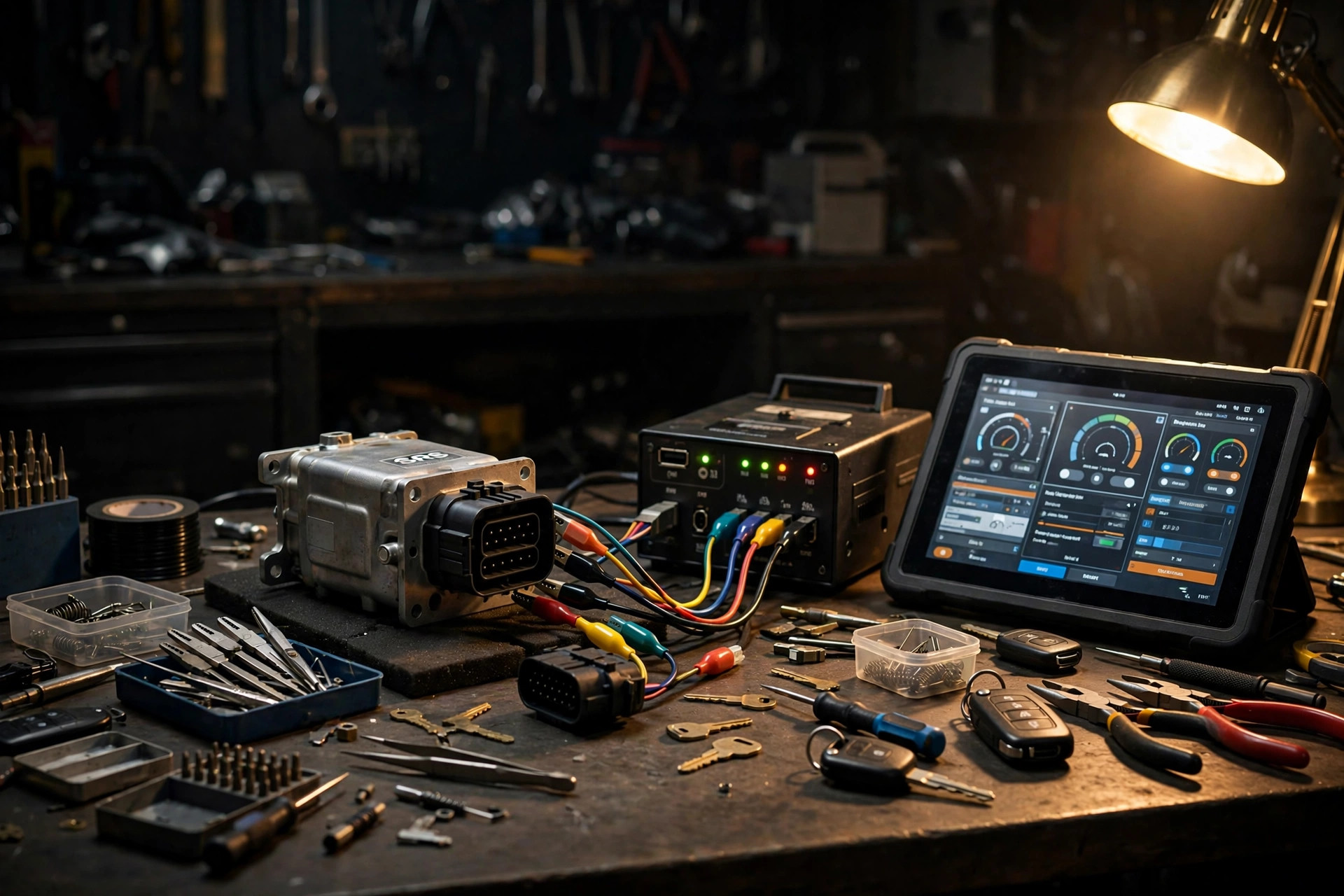
A few modules can be reset through the OBD port — plug in, clear, done. But most SRS work is bench work: the module comes out of the car, gets wired to the programmer on your desk, and the crash data is cleared at the chip level. That’s why the serious SRS tools in this list are bench tools, not code readers. If you’re buying your first SRS tool, buy for bench — OBD-only coverage will leave you turning away half the jobs.
Safety note, because this matters: an SRS module is connected to explosive devices. Disconnect the battery, wait at least 10 minutes for the backup capacitors to discharge, and handle modules with care. This is professional work, not a driveway experiment.
The picks
1. OBDSTAR P50 — the dedicated airbag reset station
The P50 is a standalone tablet (no PC needed) built for one job: SRS crash data reset. It clears crash records via OBD and on the bench, covering 100+ brands and thousands of module part numbers, with clear bench wiring diagrams. It also handles battery reset and steering-angle (SAS) reset — the jobs that show up alongside SRS work after a collision. If airbag reset is the business, this is the most complete single box for it.
2. CGDI CG70 — the SRS-only bench specialist
The CG70 does exactly one thing: reset SRS crash data, mostly on the bench over CAN (some modules via OBD), usually without opening or soldering the module. It does not do keys, mileage, or ECU cloning — it’s a pure airbag tool, and that’s its strength: simple software, wide SRS coverage.
3. Ancel AR500 — the OBD + bench all-rounder
The AR500 resets SRS crash data both via OBD and on the bench, reads and clears SRS fault codes, and adds battery reset capability. A solid alternative in the same class as the P50 for shops that want OBD convenience with bench backup.
4. CGDI CG100X — the bench programmer for the tough modules
When a module won’t talk over CAN and needs boot-mode / chip-level access, that’s CG100X territory: the module gets opened and wired per diagram (sometimes soldering), and it can decrypt and clear crash data on encrypted Renesas RH850 modules that simpler tools can only diagnose. It also covers dashboard mileage and BCM work.
5. OBDSTAR MP001 — the P50’s companion, not a standalone SRS tool
The MP001 doesn’t reset crash data on its own — it’s the programmer module the P50 uses to read and write airbag ECU data on encrypted modules during a reset job. If you run a P50, this is what extends its reach into the hardest modules.
What to check before you buy
The supported-module list matters more than the marketing. Every one of these tools publishes which SRS part numbers it covers. Look up the exact module number from the customer’s car before you buy the tool — or before you quote the job.
Updates are the real subscription cost. SRS coverage expands with software updates. Check what a year of updates costs for each platform and factor it in; a cheap tool with expensive updates is not cheap.
Bench adapters add up. Bench work needs the right cables and adapters for each module family. Budget for them — the tool is the entry ticket, the adapters are the recurring fare.
FAQ
Is resetting crash data legal?
Clearing crash data as part of a legitimate repair is standard industry practice — it’s how independent shops and mail-in services keep cars on the road without dealer-priced modules. What’s restricted is selling airbag components themselves: marketplaces like eBay prohibit airbag parts sales, which is exactly why the reset service model exists.
Can I reset an SRS module through OBD?
Sometimes. A minority of modules allow it. Most require bench access — the module comes out and gets wired to the programmer. Buy the tool for bench work and treat OBD resets as a bonus.
Do I need to remove the module from the car?
For most makes, yes. It’s usually under the center console or a seat, held by a few bolts and one big connector. The removal is the easy part; the bench work is the skill.
What if the airbags actually deployed?
Deployed airbags must be replaced — no tool resets a blown airbag. The reset applies to the control module’s crash record. The module gets reset, the deployed bags get replaced, the system gets scanned and verified. All three steps, every time.
As an affiliate, Xmart Auto Tools earns from qualifying purchases made through links on this page — at no extra cost to you.